
Fraud rarely starts with technology. It starts with a message that looks real, and with the one minute in which nobody thinks twice. This app trains exactly that minute — phishing, fake invoices, support calls — without an account and without a server.
 Requires iOS 18 or later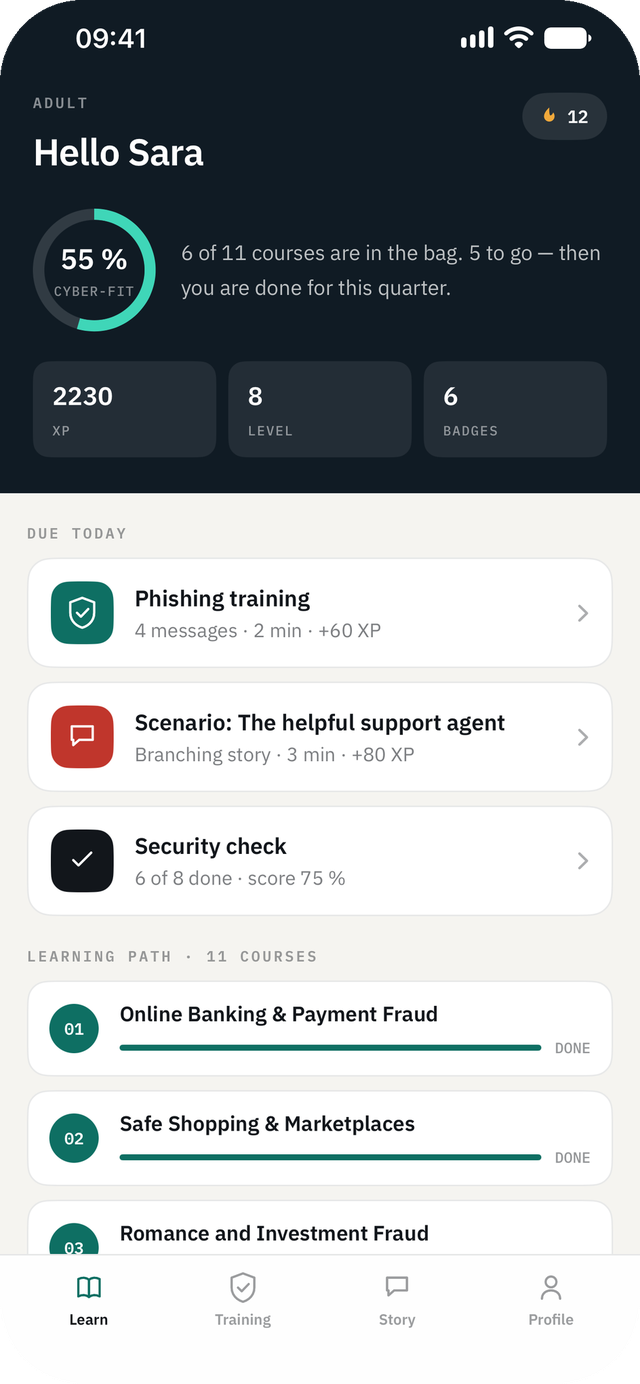
Shown in English with US examples — the app also speaks German, French and Italian, and swaps the brands, domains and emergency numbers for your region.
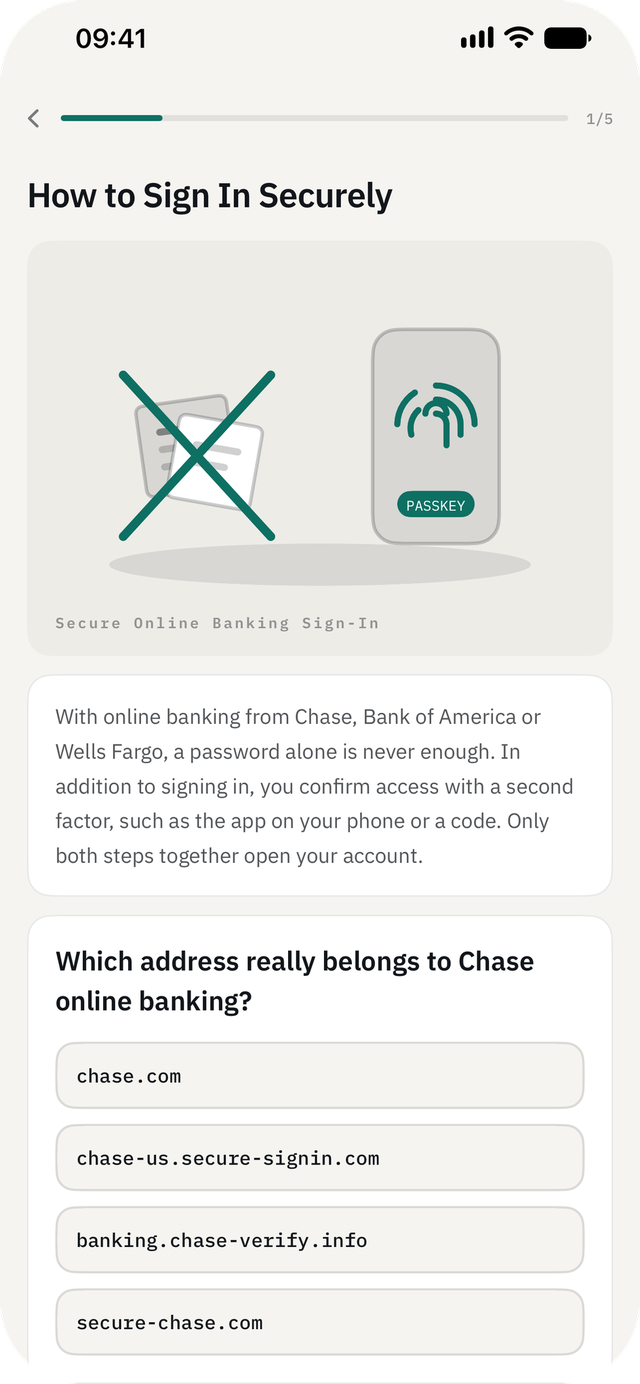
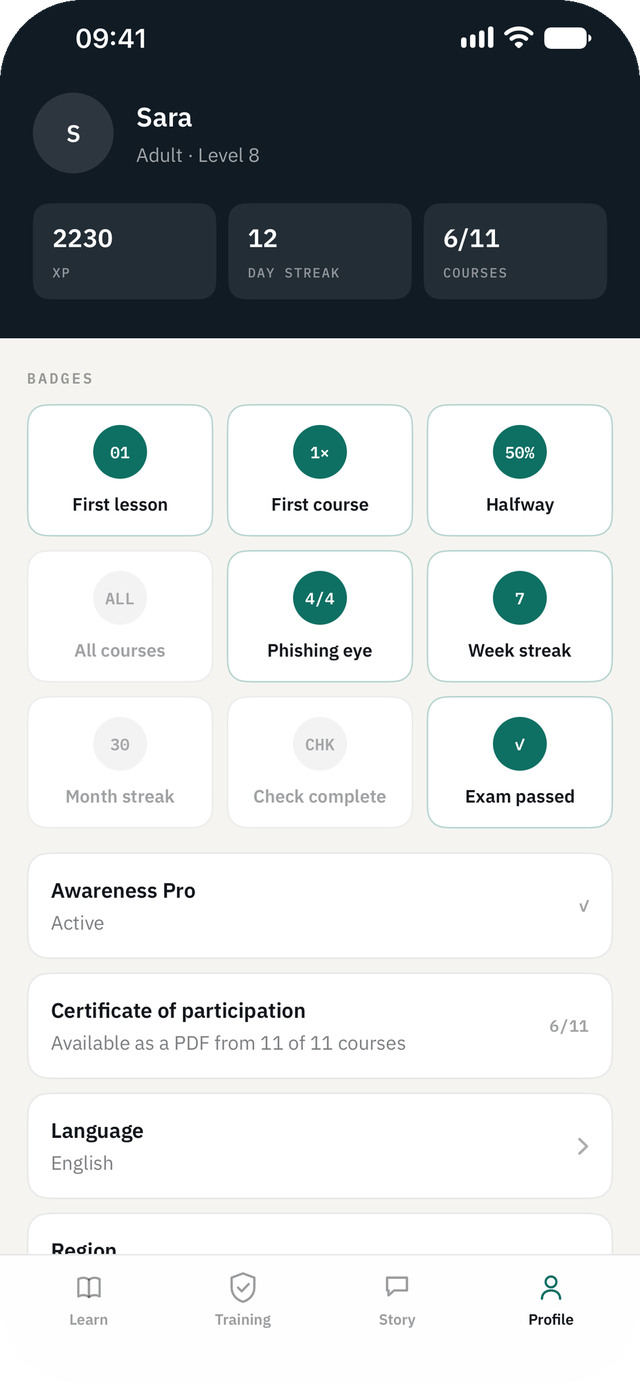
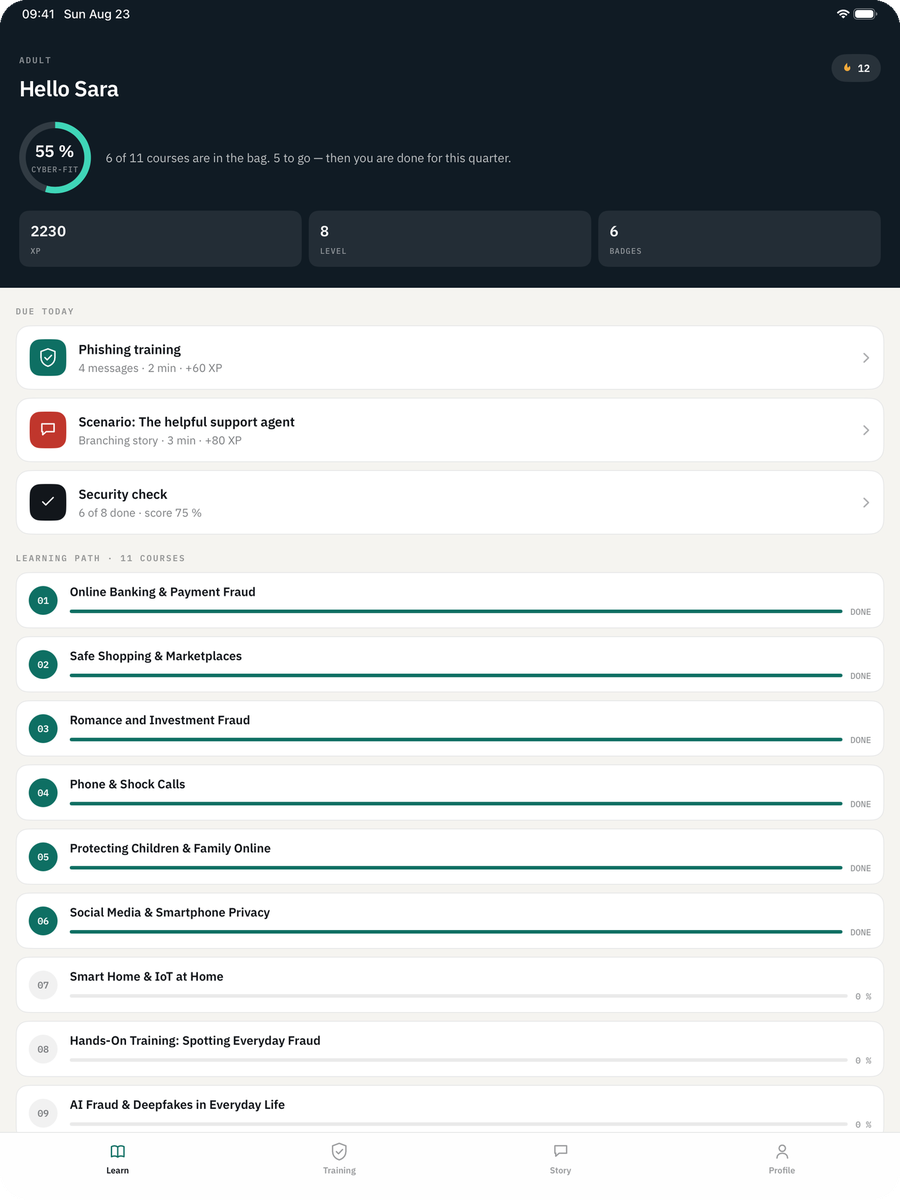
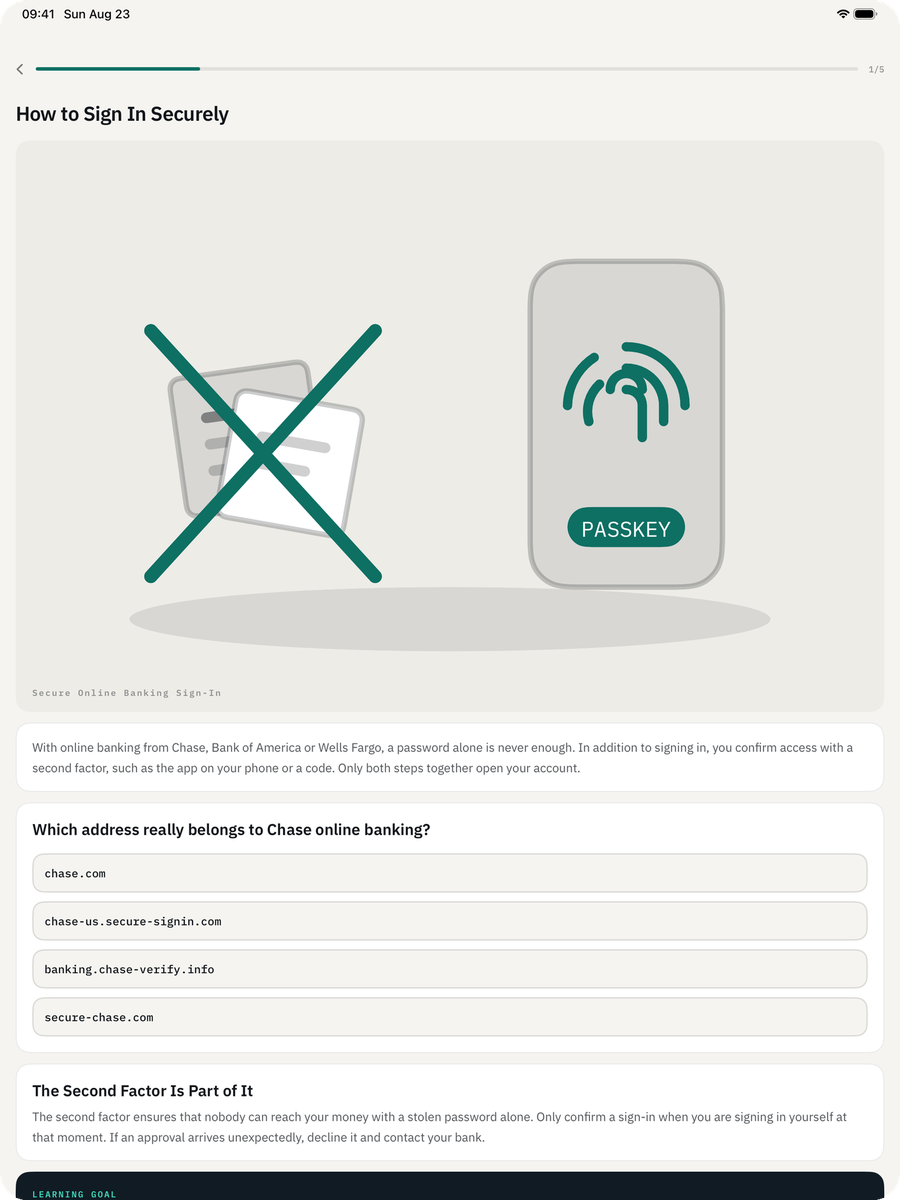
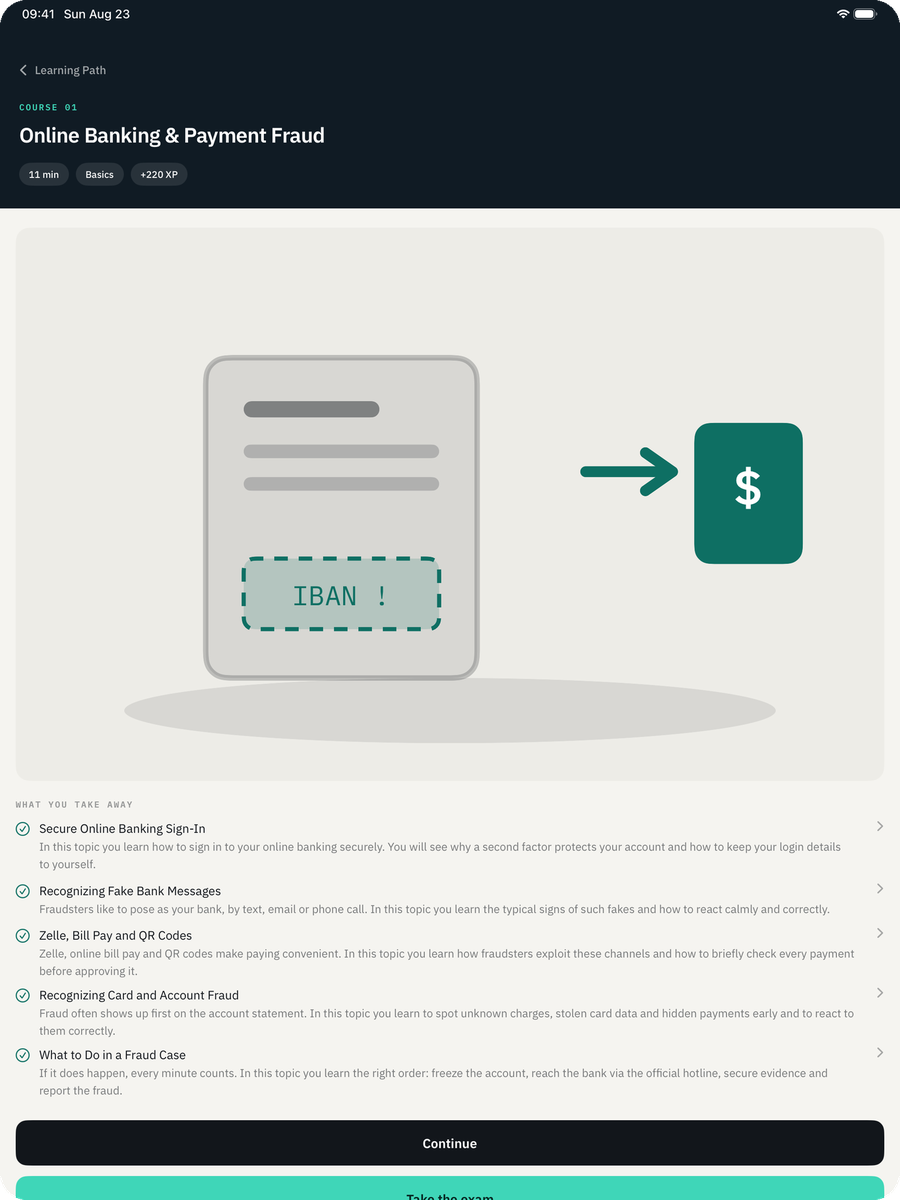
Every lesson is a short text, an example, and then the thing itself: which address really belongs to the bank, which message is phishing, what to do once the money is already gone.
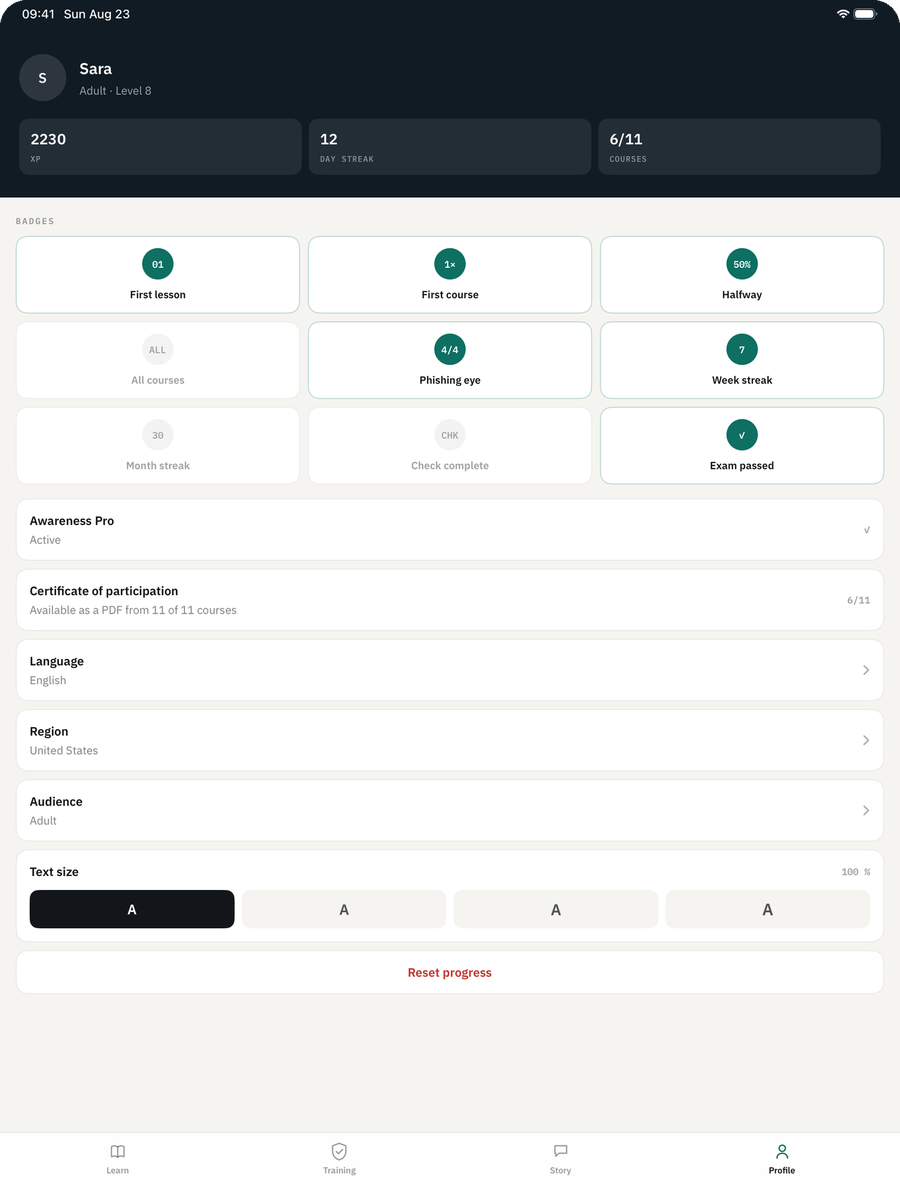
Child, teenager, young adult, adult, best ager or senior. The choice decides which courses, examples and forms of address you get — gaming and chats for some, grandparent scams and phone fraud for others.
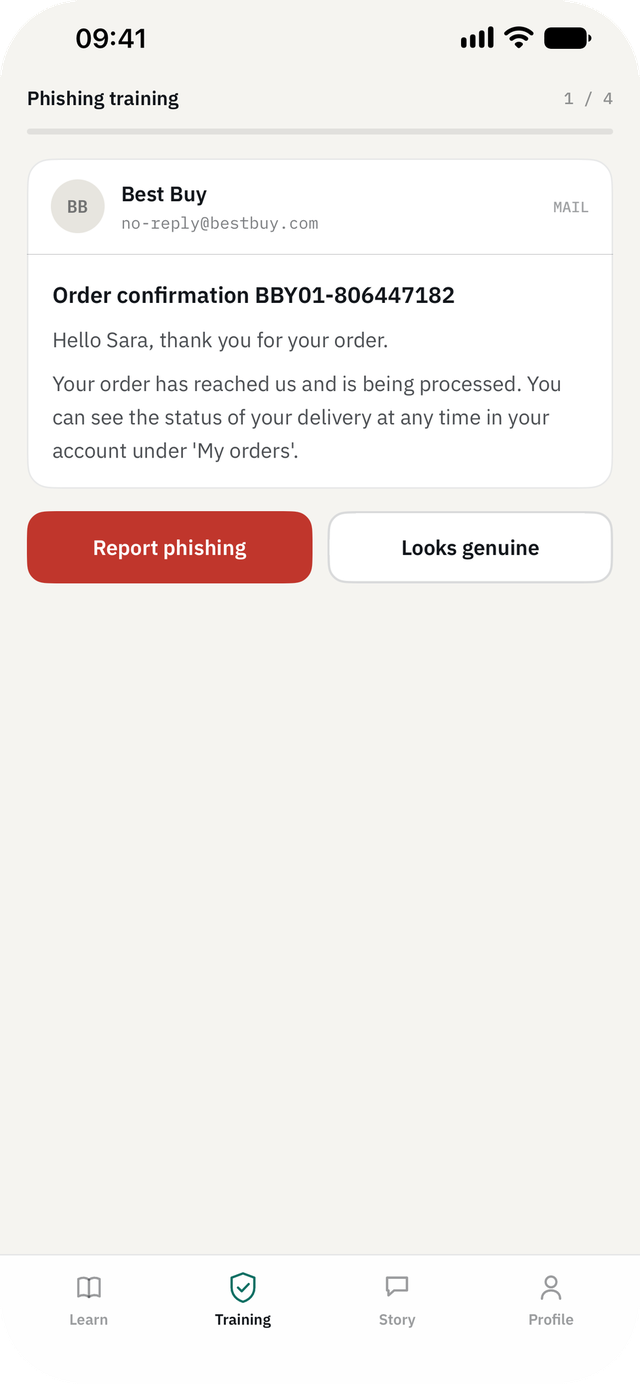
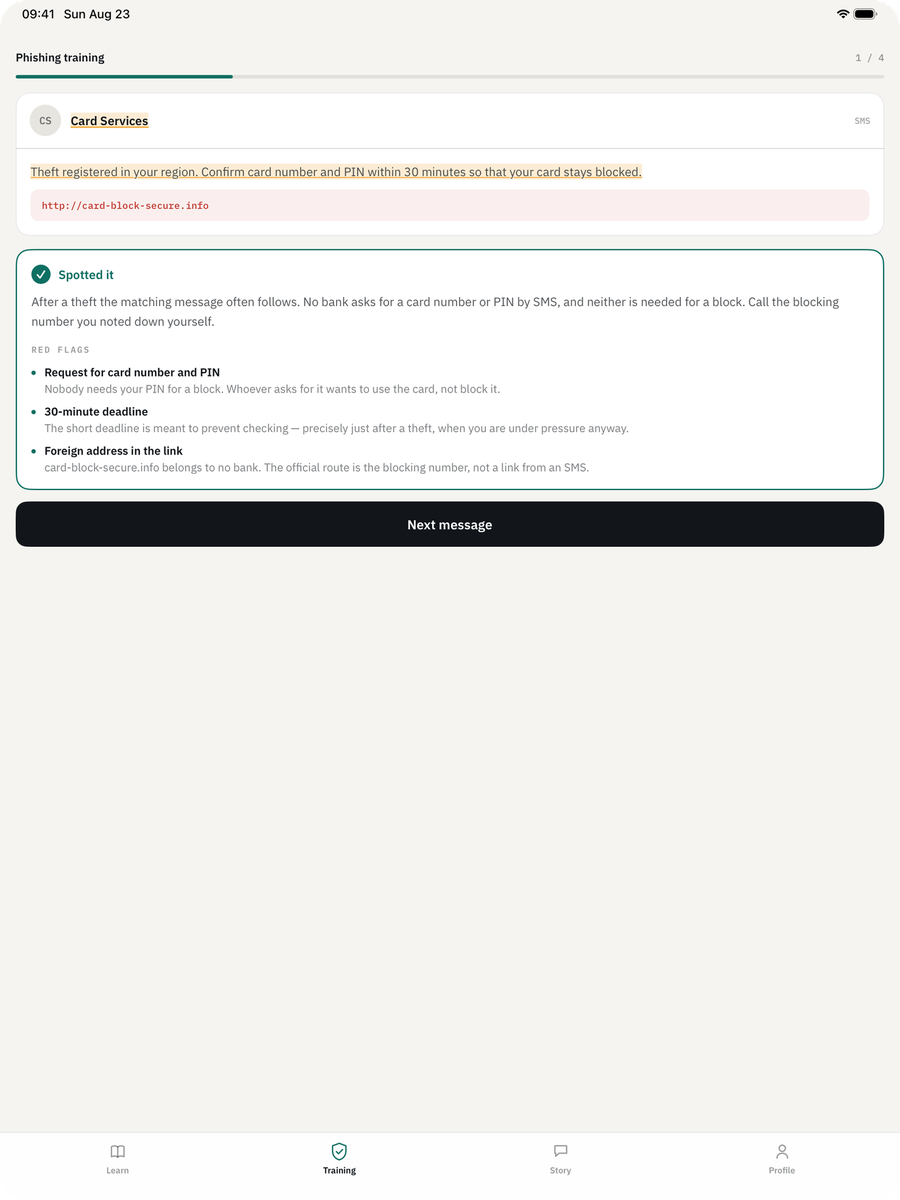
Four messages, two minutes: report or trust. After every answer the app marks the warning signs in the text — the unfamiliar sender domain, the two-hour deadline, the payment route that bypasses the platform.
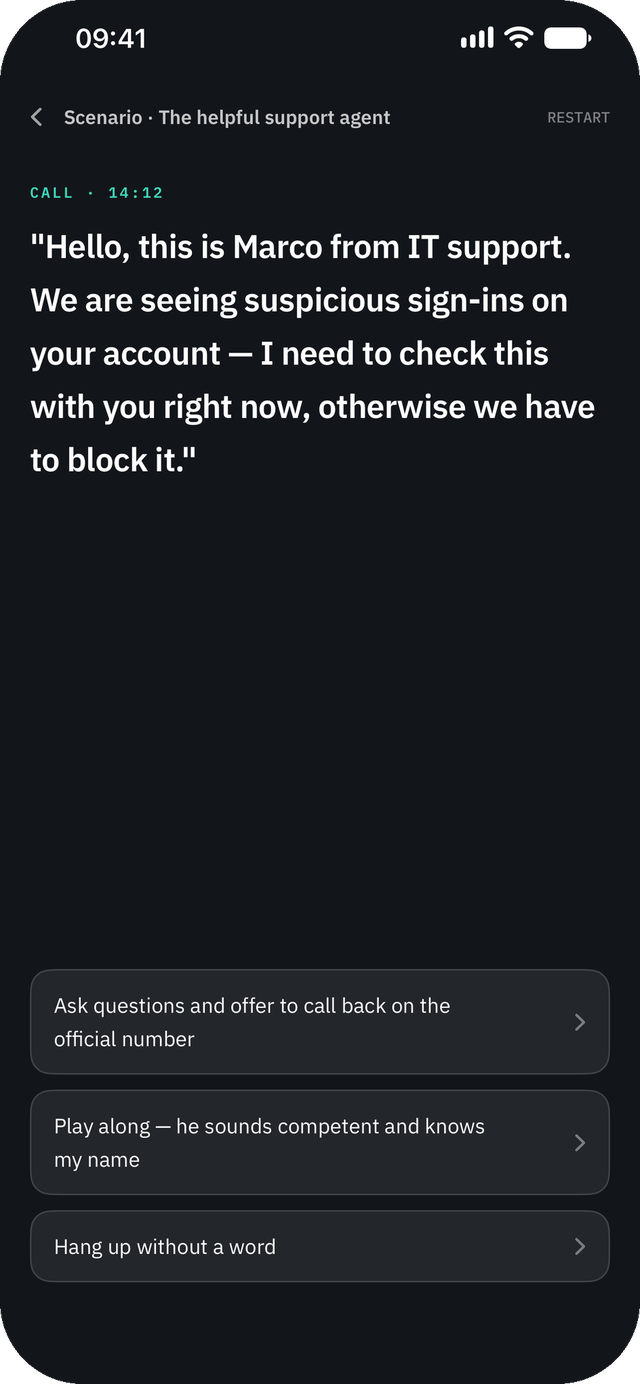
A call from «IT support» reporting suspicious logins. You decide how it continues — and you see what your decision sets in motion.
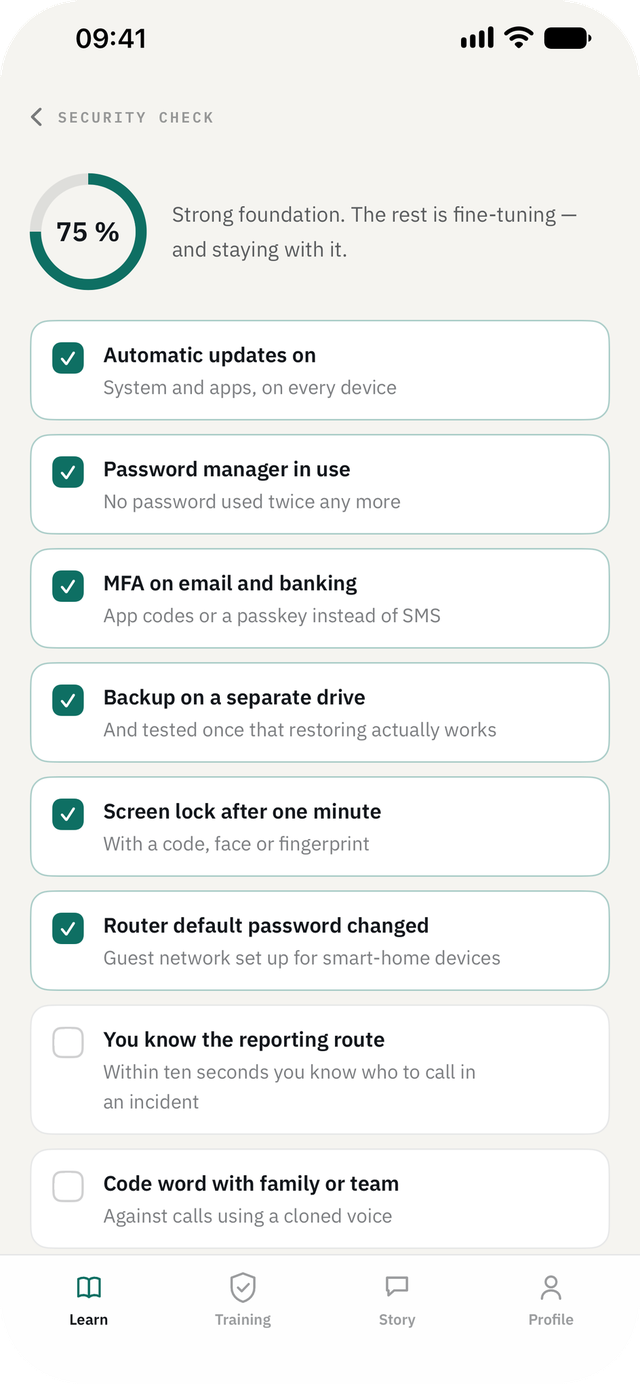
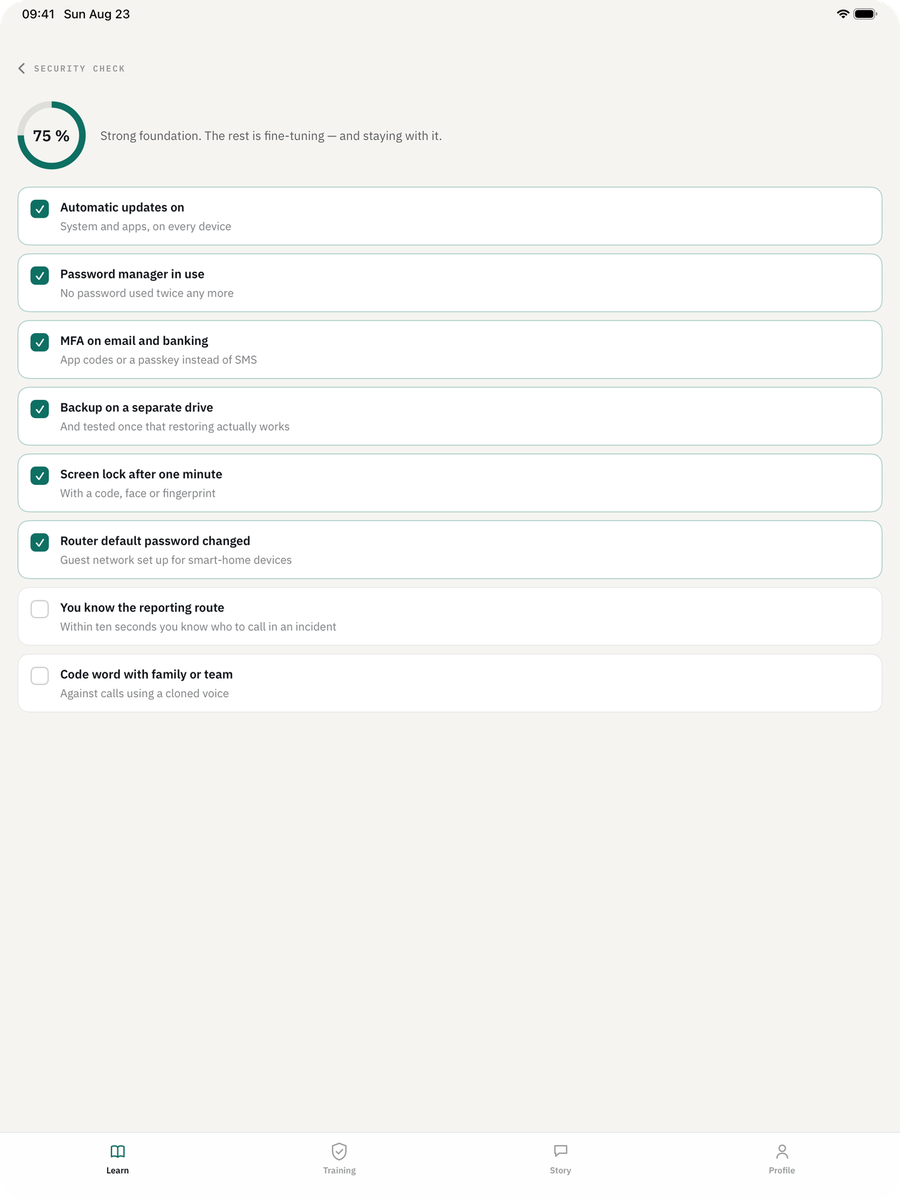
Eight points that actually matter day to day: automatic updates, a password manager, MFA on mail and banking, backup, screen lock, router, the reporting path — and a code word against calls with a cloned voice.
Brands, domains, emergency numbers and reporting offices change with your region — PostFinance, TWINT, QR-bill and 117 in Switzerland, the local equivalents elsewhere.
The entire course catalogue sits inside the app. No login, no cloud, no ads, no tracking. Your progress stays on the device. In airplane mode everything works exactly the same.
Phishing training · what it looks like
Report or trust? After you answer, the app does not just say right or wrong — it shows you what gave the message away.
Dear customer, unusual activity was detected on your account. Confirm your details within 2 hours, otherwise your access will be blocked permanently.
What gave it away
Language decides the interface. Region decides the brands, domains, emergency numbers and reporting offices inside the lessons — because «German» says nothing about whether the police number is 117, 110 or 133.
The free version is a real course, not a preview: the first course in full, exam included — and a round of phishing training every day.
The first course, permanently.
Per year. The usual choice.
Per month — or USD 199.00 once, without a subscription.
Free to download. Prices in US dollars as listed on the App Store; you pay in your own currency. Subscriptions renew until cancelled in the App Store account settings; the one-time purchase never renews.
No data is collected. That is not an interpretation but a property of the build: the app makes no network requests at all. Your progress is a file on your device.
Awareness, not a certification.The app issues its own certificate of participation once all courses of the selected audience are complete. It documents what you worked through — it is not an accredited certification and no examination body stands behind it.
The examples are regional.Emergency numbers, reporting offices and youth counselling services are kept per country. If something is out of date where you live, write to us — that is worth more than a generic example.
Free to download. No account needed — the first course is yours in full, exam included.
Support
Write to us — in German or English. We answer within two working days.
info@treeinspired.com treeinspired GmbH · Switzerland · Imprint · Privacy · Terms